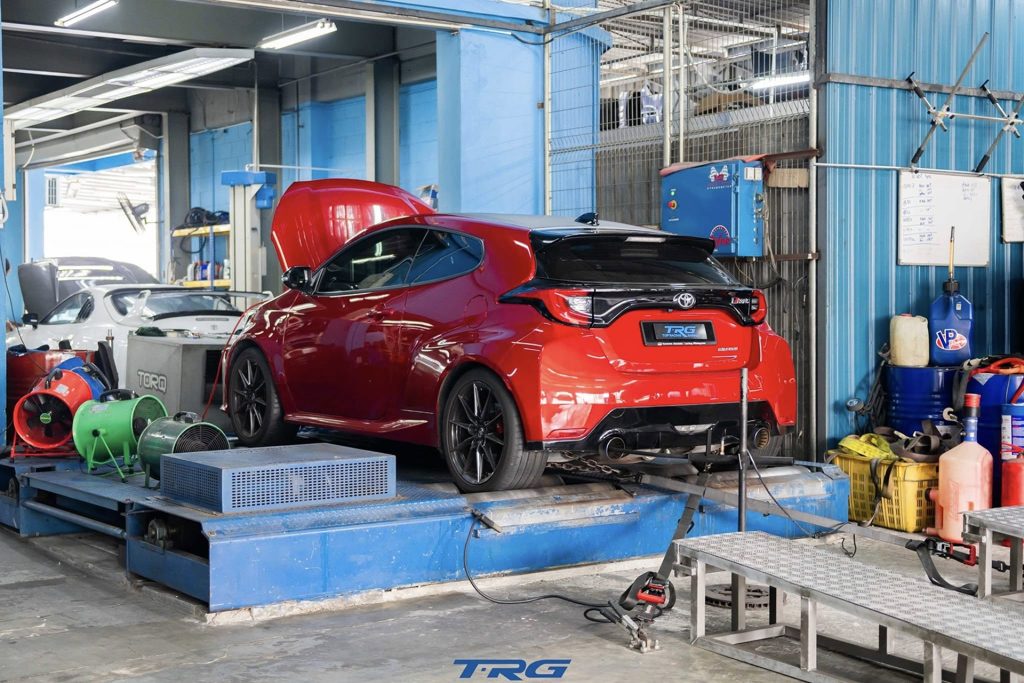
“Is that number real?” That is the first thing people ask me when someone drops a dyno graph into a group chat. Usually I can’t say, because a peak figure with no run conditions behind it tells you almost nothing.
A dyno test, short for dynamometer test, measures the power and torque your car puts down through its wheels across the whole rev range, under real load. You get a graph of horsepower and torque plotted against RPM. Every custom dyno tune Malaysia starts here.
What a dyno actually measures
Two things, mainly: wheel horsepower and torque. Torque is the twisting force that shoves you back in the seat. Horsepower is how quickly that force gets delivered. Put both against RPM and you can see where your engine is strong and where it goes flat. Two cars can share the same peak horsepower and feel nothing alike, one pulling hard from 3,000rpm, the other lazy until 5,500rpm. A single peak number hides all of that.
Note that’s wheel horsepower, not crank. The brochure figure is measured at the crankshaft, before the gearbox, driveshafts and tyres take their cut, so a car sold as 570hp always reads lower on the rollers. Don’t panic at the drop. What matters is the measured figure and the shape of the curve.
Why a baseline run comes first
Before anyone touches your tune, we run a baseline pull and keep the graph exactly as the car sits. That baseline shows your real power, your air-fuel ratio, whether the engine is pulling timing because of knock, and whether something is already wrong. A car the owner swears is healthy will often show a lean spot or a boost leak he has never felt on the road. Better to find it on the rollers than halfway through a tune. At the end you get the before-and-after graph.
Why “load-bearing” is the whole game
This is what separates a serious dyno from a toy. A cheap one lets the wheels spin the rollers freely and reads off the speed. On the road your engine fights load all the time: a hill, four passengers, or a steady 120km/h on the highway with the turbos working. A load-bearing dyno holds the car at a fixed speed or RPM and pushes back, so the tuner can watch how the engine behaves under sustained stress. That’s where knock shows up, and where a tune proves it will hold together.
Ours is a Mustang Dynamometer, made in the USA, all-wheel drive and load-bearing. My dyno can handle 1,000 horsepower, and I can run it from morning till night. Belt-type dynos overheat and need a rest between runs, which is a problem in our climate before you even start. Very few workshops in Malaysia own one.
Why a custom dyno tune in Malaysia beats street tuning
Some tuners do it all on the road, laptop on the passenger seat, adjusting on the move. On the street you can’t control traffic, gradient, temperature or the law, and you can’t safely hold the engine at high load long enough to read air-fuel ratio and knock. If the map goes lean at full boost, you find out when something breaks.
Real ECU tuning Malaysia means raising the numbers step by step and confirming the engine is happy at each one. On a GT-R we start boost low, around 1.0 bar, then work up gradually while watching the data. The deeper comparison is in custom tune versus a flash tune.
Frequently asked questions
What is a dyno in simple terms?
A dyno, short for dynamometer, measures how much power and torque an engine produces. Your car’s wheels sit on big rollers, the engine runs against them, and the dyno records the numbers across the rev range. It turns “it feels fast” into a graph you can trust.
Will a dyno test damage my car?
No, when it’s done properly on a load-bearing dyno with cooling fans and monitoring. The engine works hard, like a spirited drive, but a good tuner watches temperatures, air-fuel ratio and knock throughout and stops if anything looks wrong. It’s far safer than testing power on a public road.
What’s the difference between a dyno test and a dyno tune?
A dyno test measures your current power and torque and gives you a graph. A dyno tune uses the dyno to change the engine’s ECU calibration, pull by pull, to make more power safely. Every good tune includes testing; not every test is a tune.
If you’re planning any work on the car, book the baseline pull first and keep the graph. Even if you tune nothing afterwards, you now know what your engine is actually doing. Come by the shop in Bandar Sunway and watch your own run.
Ready to see your own numbers? WhatsApp TRG to book a baseline dyno pull, or drop by the workshop in Bandar Sunway. Chat with us on WhatsApp.