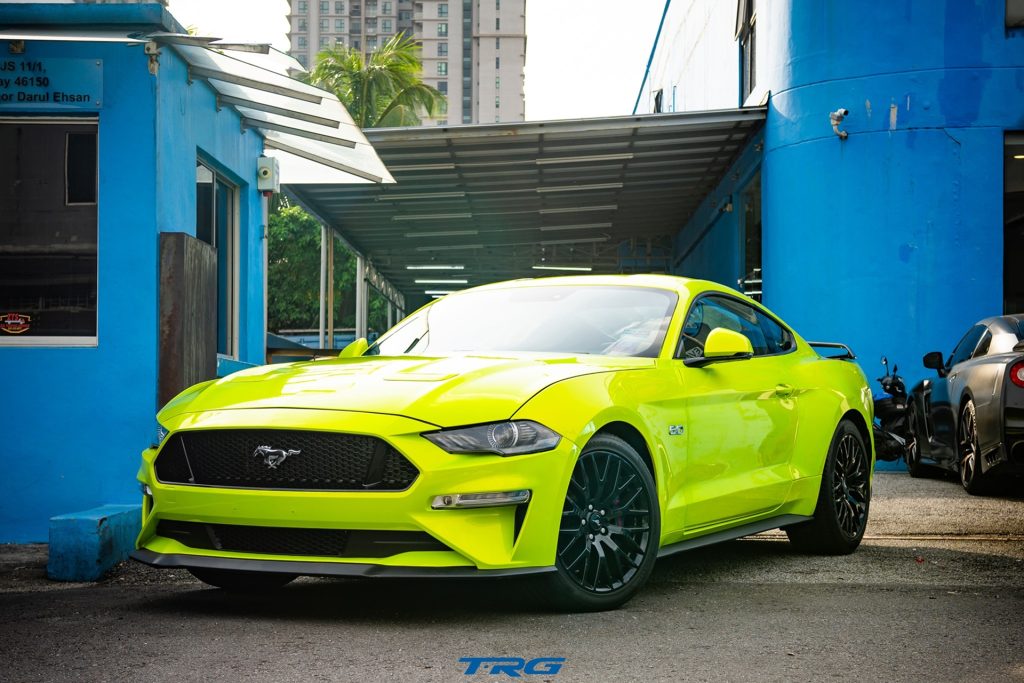
A customer once sent me a video of a stock-cooled Mustang running 10psi in America, holding perfect timing pull after pull. “Can we do this?” he asked. Sure, I said, if you move to Michigan. His car lives in Klang Valley, where engine bay air is already 34°C before the blower touches it.
Mustang cooling upgrades come before supercharging because compressing air makes it hot, and hot intake air forces the ECU to pull timing to avoid detonation. In Malaysia’s 30 to 36°C ambient, a stock intercooler and radiator cannot shed that heat fast enough, so the engine loses power and, at worst, damages itself.
The heat tax on boost
Push more air into an engine and it makes more power, but the tax on that air is heat. A blower squeezing air to 8 or 10psi raises the charge temperature sharply. Feed that charge through an intercooler sitting in 35°C ambient and the cooler can only pull it back toward the air around it. If that air has heat-soaked to 40°C, that is roughly your floor.
Intake air temperature, IAT, is one of the first numbers the ECU watches. When IAT climbs, the Coyote’s factory logic pulls timing to stay out of knock, and less timing means less power. So you spend RM60,000 to RM100,000 on a kit, cooling and install, and on a hot afternoon the car quietly hands some of it back. On a bad day the charge gets hot enough that detonation starts, and now you are shopping for a piston. The full line-by-line is in our Mustang supercharger cost breakdown.
Mustang cooling upgrades in the order that matters
We work through cooling in a fixed order, because money at the top of the list buys more safety.
The charge cooler is first. Most kits run air-to-water, with a front heat exchanger, a pump and a cooler core in the intake path. The factory exchanger is sized for a cooler climate, so in our heat you want the largest front-mount exchanger that will fit. On the dyno an undersized one gives one good pull, then IATs stack up and every pull after is worse.
Radiator capacity comes next, since a stock radiator already works hard in a KL jam and a thicker core keeps coolant safe once you add boost. Then oil, which is a coolant too. It thins out when it gets too hot and stops protecting the parts hardest to replace, so we run Motul 300V on performance builds. Last comes a high-flow water pump and clean ducting, because a big exchanger does nothing if coolant is not moving, and cores choke if air cannot get back out.
None of this is exotic. Heat exchangers, cores, pumps and oil coolers sit in our Mustang cooling parts catalogue, alongside the other brands we work with on Mustang builds.
The heat-soak test that overseas videos skip
Heat soak is what happens when the car stops moving and everything under the bonnet keeps making heat with no airflow. On a highway pull, air blasts through your coolers. Sit in a toll queue on the Federal Highway at 5pm, 35°C outside, and heat exchanger, radiator and engine bay all climb together. Floor it when the gap opens and the charge going in is far hotter than any dyno pull showed, exactly when detonation risk is highest.
A dyno sheet is made in the best conditions and real Malaysian driving is close to the worst. That gap is the margin your cooling has to cover, which is why we build a custom dyno tune Malaysia around your actual cooling and fuel rather than flashing a file borrowed from another car.
Frequently asked questions
Do I need cooling upgrades before supercharging a Mustang in Malaysia?
Yes. Our 30 to 36°C ambient is far hotter than the conditions most kits are validated in. Without a bigger heat exchanger, adequate radiator and oil cooling, intake air temperatures climb and the ECU pulls timing to avoid knock. You lose power and raise detonation risk.
What causes heat soak on a supercharged Mustang?
Heat soak happens when the car stops moving and airflow through the coolers stops, but the engine, supercharger and heat exchanger keep radiating heat into a still engine bay. Intake temperatures spike, so the next time you accelerate, that hotter charge enters the engine when detonation risk is highest.
Can’t a good tune just fix the heat problem?
No. A tune manages the heat you have, it does not remove it. The ECU can only pull timing to stay safe, which costs power. Fix the cooling first so the tune has some thermal headroom to work with.
If a kit quote lands on your phone with no cooling line on it, that is your cue to ask what happens on the third pull. Send me the quote and I will tell you what is missing from it.
Not sure if your cooling can handle a blower yet? WhatsApp TRG with your Mustang’s mods and we’ll tell you what to fix first, before you spend on boost. Chat with us on WhatsApp.